To fully understand the commencement of the 5th World Congress of Psychogeography, it might help to read about its previous iterations and history.
4WCoP Closing Speech
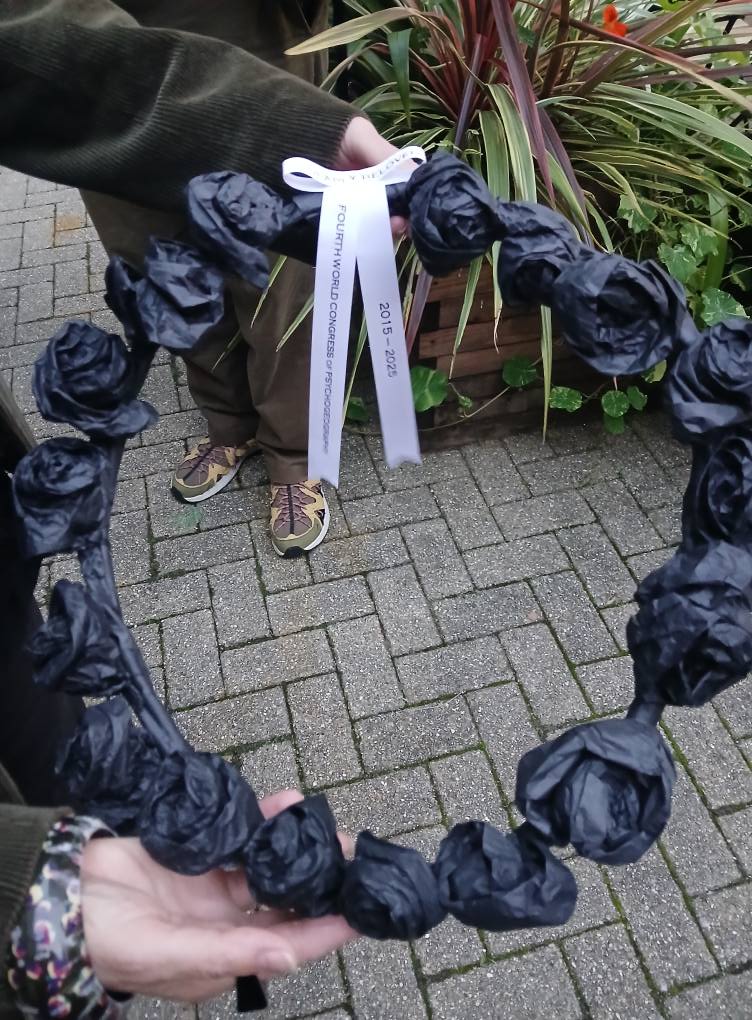
4th World Congress of Psychogeography – Swansea 2025 Closing Event- Words – Carl Meddings
I promise to tell the truth, the whole truth and nothing but the truth.
I’d like to tell you about the history of the 4th World Congress of Psychogeography.
Much of what I’m about to say might be true, but could just as easily be a romantic fabrication. So, don’t take what I say as actual instruction. Treat it more like a psycho-geographer might look at a map drawn by a situationist from memory. I can no longer remember where this information came from. Call it research, call it guesswork, call it imagination, I don’t know. But, for the sake of argument, let’s just assume it’s true.
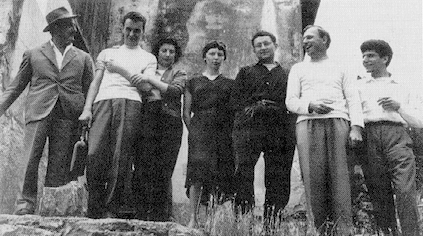
The First World Congress of Psychogeography was held in Cosio d’Arroscia, Italy, in 1956. It involved the Situationist International (amongst others), a group led by Guy Debord. Actually, this event prefigured Psychogeography as a movement. Guy Debord had coined the term a couple of years earlier, but it was yet to take hold, so they didn’t know at the time that their event was actually the First World Congress of Psychogeography. To be fair, they didn’t really know what they were up to, or ironically, where they were going. One might say the movement, in its infancy, was drifting. They even got the name wrong because they mistakenly called their meeting in Italy the First World Congress of Free Artists. Still, we know now, with the benefit of hindsight and the ability to rewrite history, that it was in fact the First World Congress of Psychogeography. We know it’s true because ChatGPT told David Upton, and he told me in a bar in Canterbury last year. I think.

For the next chapter in the story, we turn to Paris in the early 60s. To be fair, it wasn’t a congress or conference in the modern academic sense. Guy Debord and others had set up Lettrist International and later the group Situationist International in the 1950s. In Paris, they organised meetings and public interventions that laid the foundations of psychogeography. The term gained traction through their work developing and practising psychogeography, through planned and unplanned walks, known as the derive. A way to study the urban environment’s effect on emotions and behaviour, creating maps of areas of attraction, repulsion, and ambiguity that challenged the city’s official, orderly representation. A reaction against the modern capitalist city and Haussmann’s re-planning of Paris, which prioritised purpose and order over chance and emotion. From our modern perspective, with all the advantages of being able to invent the narrative (by being a keyboard warrior) we can see that these early gatherings, happenings, contemporary art, geography, or urbanism festivals and ramblings were, in fact, effectively the Second World Congress of Psychogeography. At any rate, we deem this to be so.

According to Wikipedia, the London Psychogeographical Association (LPA), sometimes referred to as the London Psychogeographical Committee, was an organisation devoted to psychogeography. We are led to believe that it was first mentioned by the British artist Ralph Rumney as one of the organisers (apparently) of the “First Exhibition of Psychogeography” in February 1957 at the Taptoe Gallery in Brussels, which included his work. According to some accounts, the group eventually merged into the Situationist International. This was apparently quite a straightforward thing to do, as Ralph Rumney was in fact the only member of the ‘London Psychogeographical Association’ and the move had his full backing. However, Rumney was “amiably” expelled from the Situationist International by Guy Debord for “failing to hand in a psychogeography report about Venice on time.” Rumney spent much of his life living as a wanderer, and was variously described as both a “recluse” and a “media whore”, seeing his existence as a “permanent adventure and endless experiment.” Rumney married into the Guggenheim family and moved, as his friend Guy Atkins noted, from “penury to almost absurd affluence”. Apocryphally, (and according to my mate Graeme Murrel) Rumney organised the Third World Congress of Psychogeography in London in the 60s, but nobody turned up (except Rumney), so the event was abandoned. We have no way of knowing if this was true. Graeme can’t remember where he heard about this. He thinks it may have been David Upton again, but isn’t sure. David doesn’t recall but liked the idea. So, for the purposes of this historical review, we decided to just roll with it…
It was with this in mind (or something like it) that Alex Bridger, Phil Wood, and others were involved in establishing the 4th World Congress of Psychogeography, in Leeds in 2015, to celebrate the launch of Tina Richardson’s book: Walking Inside Out: Contemporary British Psychogeography (Place, Memory, Affect). The congress was held over a weekend, and included a very robust Saturday evening in Leeds, followed by a fairly fragile Sunday morning happening. No one was really in charge at the end of that first event, so the congress was never officially ‘closed’. The following year, it was ‘borrowed’ by Huddersfield and was enthusiastically embraced by keen ‘amateur’ psychogeographical enthusiasts, the Politburo was formed, and the rest is history, or at least, following this more or less realistic summary, it will be history. No one in the Politburo could decide if we should end the proceedings of the 4th World Congress or not. The worry was that, if we did, it might not happen again, so for 10 years, we studiously avoided anything resembling a closing ceremony.
Until today.
Dearly beloved, we are gathered here to say goodbye…